
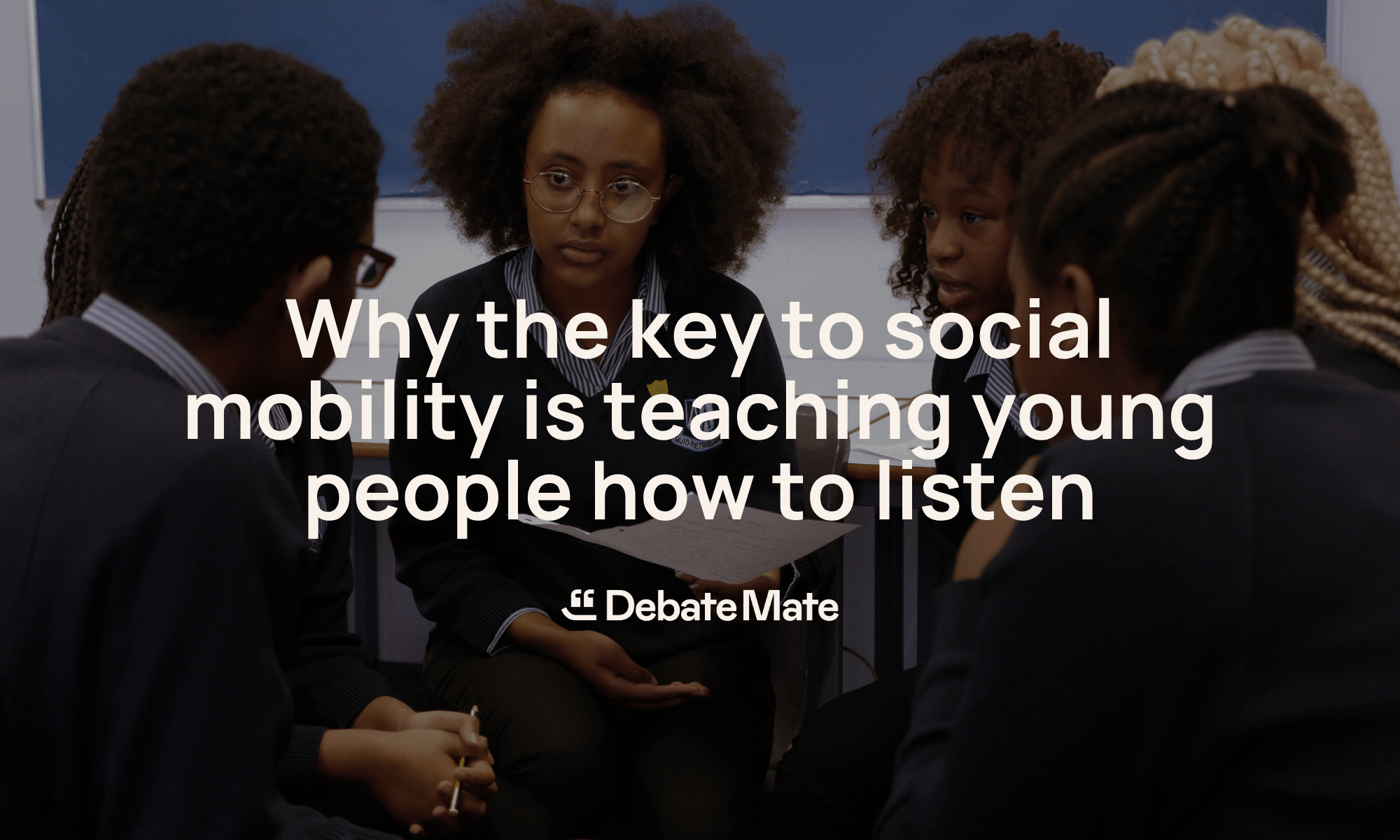
Ask most young people what debating is, and they’ll describe it as an argument – two sides, a winner, a loser. Ask the students who’ve been through a Debate Mate programme, and they’ll describe something completely different. Not winning. Listening.
Debate, by definition, involves making the strongest case for your position. Why would it teach you to listen?
Because you can’t do it without listening. And the moment students understand that, it cascades in the way they engage in class, in how they treat each other, and in the kind of thinking they bring to everything else.
The skill nobody teaches on purpose
Listening is one of the most universally valued qualities we can name. Ask any employer, teacher, or parent what they want more of from the young people around them, and listening is almost always on the list. Yet it’s rarely taught.
We teach young people to read. We teach them to write. We teach them to present, to calculate, to memorise, to recall. We do not, as a rule, teach them how to hear what someone else is actually saying – as distinct from waiting for them to stop talking.
Debate Mate teaches it on purpose. And the way it gets taught is through the practice of debating itself.
Why debating forces you to listen
In a structured debate, you don’t get to choose your topic, and you don’t always get to choose your side. You might be asked to argue for a position you personally disagree with. You need to understand it well enough to make the best case for it.
That requires something most people find surprisingly difficult: genuinely engaging with a view you don’t share.
It means listening to the other side’s arguments – not to dismiss them, but to understand them. Identifying what’s actually strong in their position. Finding the real point of disagreement, rather than attacking a version of the argument that was never made.
Students who go through this process regularly – across a range of topics, teams, and opponents – don’t just get better at debate. They get better at listening. Because they’ve learned what genuine listening actually delivers: information you couldn’t have predicted, angles you hadn’t considered, arguments that change your thinking.
What teachers tell us they see
The teachers who run our programmes describe a consistent pattern. In the early weeks, students tend to talk over each other, but by the end of a programme the same students ask more questions. They pause before responding. They challenge each other’s ideas without dismissing the person holding them. They notice when someone hasn’t been heard, and make space for them.
This isn’t just good debate practice. It’s good social practice. And teachers who spend their days managing classrooms full of competing needs, personalities, and pressures, notice it immediately.
The Debate Mate programme has been a fun, engaging, and really valuable experience for our students. It gave them a great space to build skills like critical thinking, persuasive speaking, active listening and working as a team.The students have grown in many ways: some quieter students really came out of their shells and started speaking up more, students improved their vocabulary and were able to explain their thoughts more clearly, many felt more confident and proud of their contributions, and others became better listeners more aware of current issues. Thank you so much and we look forward to working with you next year.
The confidence that comes from listening
There’s a counterintuitive thing that happens when young people learn to listen well: they become more confident, not less. The instinct is to assume that confidence comes from speaking – from having a strong voice, a ready answer, a well-practised point. But there’s a different kind of confidence that comes from knowing you’ve actually heard the other person – from feeling secure enough that you don’t need to fill every silence, perform certainty you don’t have, or dismiss an idea before you’ve understood it.
Students who develop that kind of confidence carry it into classrooms, interviews, friendships, and the world of work in a way that quieter, more defensive certainty never quite manages.
There’s a quiet inequality at the heart of this, too. The ability to listen well, to engage across difference, to hold your position while genuinely considering another, has historically been modelled and taught to a particular group of young people.
Those whose home environments, schools, or social networks showed them what it looked like.
Teaching it deliberately changes that equation. It puts the same skill in reach of every student, regardless of background, regardless of what’s been modelled at home.
That matters for the individual student. It also matters for the communities and workplaces they’ll go on to shape. The world has more than enough people who can hold their ground. It could use more who know how to hear.
→ If you’d like to explore bringing Debate Mate into your school, organisation, or programme, get in touch at debatemate.com.
