
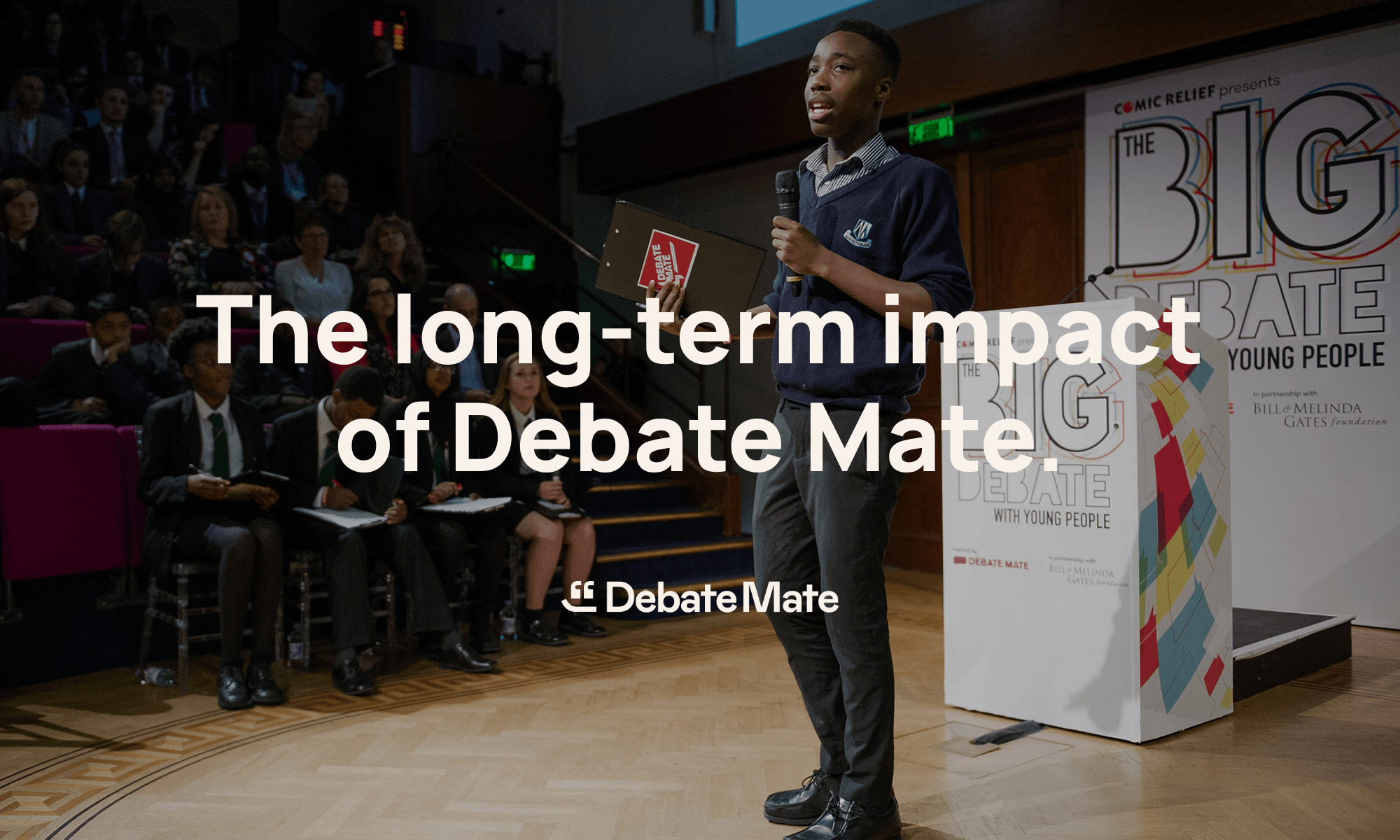
Ella Cox was 12 years old when she first walked into a Debate Mate session at The Bridge Academy in Hackney. She was not an obvious future Yale graduate. She was a secondary school student in one of London’s most economically disadvantaged areas, trying something new after school.
Fifteen years later, she is a future trainee solicitor at Freshfields Bruckhaus Deringer – one of the world’s top law firms – and a core part of the Debate Mate alumni network that now mentors the next generation.
Her story raises an important question. When we talk about the impact of debate clubs and oracy programmes, what are we actually measuring? And how long does it last?
What the Immediate Data Shows
The short-term impact of debate training is well documented. Debate Mate uses a bespoke Speaking and Listening metric, developed in consultation with teachers and aligned to the National Curriculum, to track student progress from the first session to the last.
Students progress an average of 1.4 levels in speaking and listening across the 17-week programme. In 2022-23, that figure rose to 1.6 levels. This represents measurable, moderated progress within a single academic year — progress that 92% of teachers say has accelerated their pupils’ attainment in Speaking and Listening.
But the seven skills the metric tracks – collaboration, active listening, argument structure, use of evidence, speech structure, style, and quality of spoken language – are not just debate skills. They are the building blocks of academic performance across every subject, and of professional performance in every career.
The Medium-Term Evidence: Aspiration and Application
The soft skills picture is where the real story starts to emerge. In Debate Mate’s 2022-23 student survey, completed by 1,745 students:
88% said the skills they gained from debating will help them succeed in their future studies or training. This matters particularly because 40% of those students had parents who had not been to university, or were not sure. Many had no first-hand model of what higher education looked like – until a Debate Mate mentor walked into their school.
That is by design. Every student on the Debate Mate programme is mentored by a university student – someone from a similar background who has navigated the path they are starting to consider. 91% of students agreed their mentor was a positive role model. 90% said they liked their mentor.
When students can see the path, they begin to walk it.
The Long-Term Picture: What Alumni Do Next
Haider Nazerali started the Core Programme in Year 9 at Rooks Heath College in Harrow. He describes himself before Debate Mate as “not especially ambitious.” He did not know what he wanted to do. He did not know which crowd he fit into.
Debate Mate changed that. Haider joined the Graduate School, competed in seven national finals, won best speaker twice, and took the debate programme to Nepal as part of the Debate Mate team. He is currently studying Medicine at Imperial College London and serves as President of the Imperial College School of Medicine Students Union.
“The experience I got at Debate Mate with public speaking and defending my thoughts, even helping me understand how other people think when they say things and how to respond correctly, really helps with everything I am doing now. It was one of the best experiences of my life and completely changed what I have ended up doing.”
These are not isolated stories. Debate Mate alumni have gone on to study at Harvard, Princeton, Yale, Oxford and Cambridge. Students have been elected president of the Oxford Student Union, made the England World Schools Debating Squad, and built careers in law, medicine, policy, and business.
What Sustains the Impact
One of the most deliberate parts of the Debate Mate model is what happens after the 17 weeks finish. Students elect a president and three officers to run the debate club once the mentors have left. Teachers report that students have not only continued debating, but have gone on to run taster sessions for younger students and organise teacher-student debates on school issues.
The skill does not leave when the mentor does. That is the point.
The Graduate School extends the progression further. Students in Years 10 to 13 who have flourished on the Core Programme move into weekly coaching with world-class university debaters, employer interactions, and UCAS support.
-> 100% of Graduate School students who completed the programme re-enrolled for the following year.
-> 82% said the programme had a positive impact on their academic performance.
The Social Mobility Case
The Education Policy Institute found that by the time disadvantaged pupils leave secondary school, they are over 18 months behind their more affluent peers. That gap has grown. What debate training does is narrow it, not by teaching facts, but by building the confidence, communication and critical thinking that determine how those facts get used.
Ella Cox’s mentor at The Bridge Academy was a university student. She went on to become a mentor herself, and then a Programme Director. She now trains to be a solicitor at Freshfields. That is not just a career outcome. It is a model of what is possible – visible, relatable, and reproducible for the next student who walks into a Debate Mate session wondering if this is for someone like them.
It is.
FAQs
Debate Mate uses a bespoke Speaking and Listening metric aligned to the National Curriculum, moderated by teachers. Across 524 students from 94 schools, the average improvement is 1.4 levels between the first and last debate. 92% of teachers report accelerated progress in Speaking and Listening as a direct result of the programme.
In multiple ways. It builds the confidence to apply to more ambitious institutions, develops the communication skills that strengthen personal statements and interviews, and – through the Graduate School – gives students direct support with UCAS applications and interactions with professionals from a range of sectors.
Yes. Debate Mate’s longitudinal case studies track students from Year 5 through to careers. The common thread across alumni stories is that the skills — particularly confidence, resilience, and the ability to structure and defend an argument – prove useful in every context they encounter after school.
Debate Mate works exclusively with non-selective state schools in areas of high child poverty. 43% of students on the 2022-23 programme were eligible for Free School Meals. The programme is specifically designed for students who face the greatest barriers – and the alumni data shows that those barriers can be overcome.
