
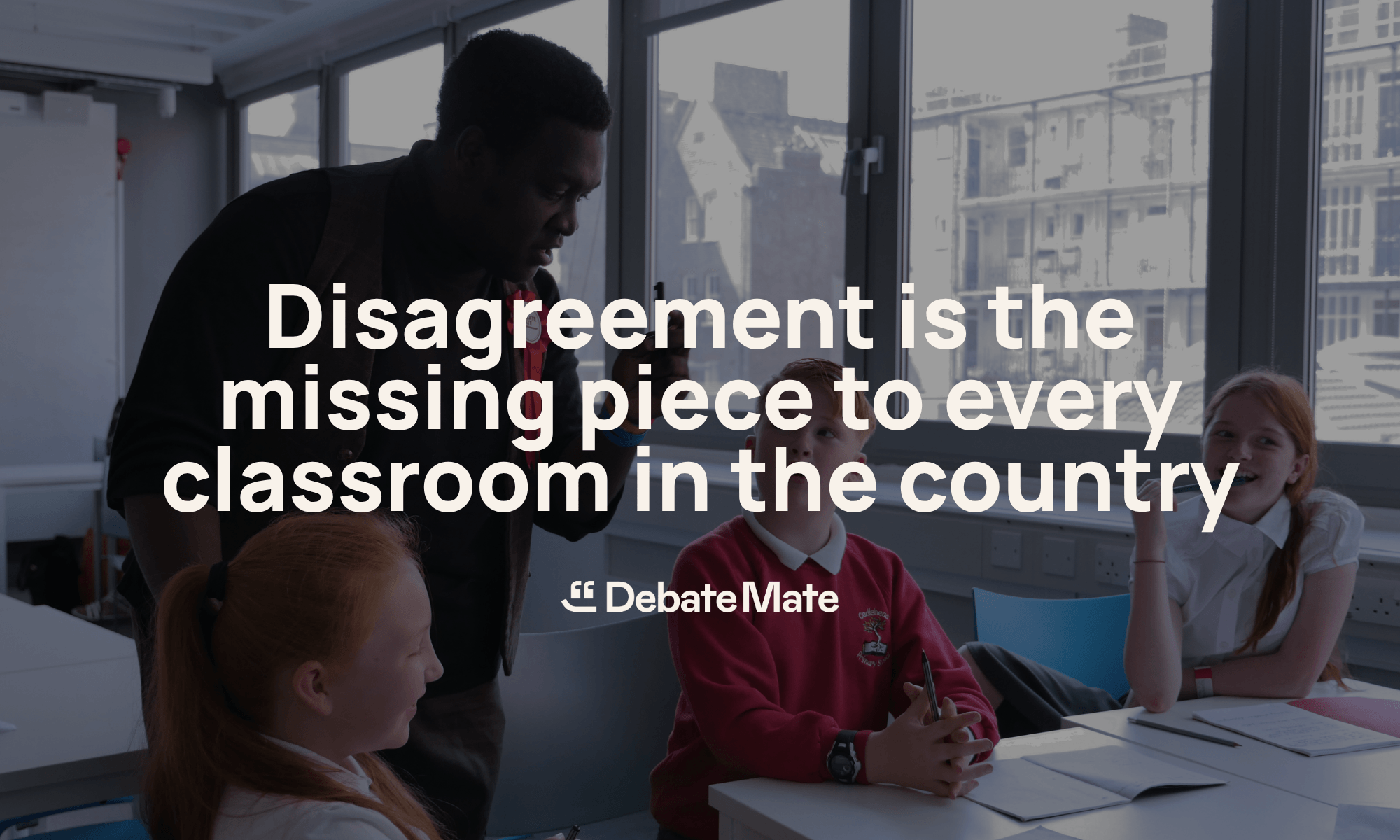
Picture a Year 9 history lesson. The teacher asks whether the First World War was inevitable. Three hands go up. Two students agree with the textbook answer. The third offers a different view. The teacher smiles, says “interesting,” and moves on.
Nobody challenged anyone. Nobody built on the disagreement. Nobody learned how to handle a counter-argument – or how to make one. This is not a criticism of that teacher. It is a description of how most British classrooms handle disagreement: carefully, quickly, and without development. And it is costing students something they will need for the rest of their lives.
Why Classrooms Suppress Disagreement
Disagreement in a classroom feels risky. For the teacher, it slows the lesson and can tip into conflict. For the student, it invites judgment – from the teacher and their peers. The path of least resistance is agreement, or silence.
Over time, students learn the implicit rule: express an opinion if it matches the expected answer. Otherwise, stay quiet.
This is not a question of intent. Teachers are managing 30 students, a curriculum, and a clock. But the cumulative effect is significant. Students leave school having had very little practice at one of the things that matters most in adult life: holding a position under pressure, challenging ideas respectfully, and changing their mind when the evidence demands it.
Disagreement Is Not the Problem. Unskilled Disagreement Is.
There is a common assumption that avoiding disagreement keeps classrooms safer. The research suggests the opposite. Students who are never taught to disagree constructively do not avoid conflict when they encounter it – they just handle it badly.
They dismiss, rather than rebut. They personalise, rather than challenge the argument. They withdraw when challenged, rather than engaging with the challenge.
The classroom is the safest environment students will ever have to practise these skills. Outside school, there is no teacher to step in. In a job interview, a boardroom, or a difficult family conversation, the ability to hold a position under pressure is not optional.
What Debate Training Does Differently
Debate Mate’s approach treats disagreement as a skill to be built in a low-stakes environment, not a problem to be managed.
In a Debate Mate session, students are assigned a position – sometimes one they do not personally hold. They have to research it, defend it, and respond when someone challenges it. The disagreement is built into the structure. It is the point.
What happens is that students learn to separate the argument from the person making it. They learn that being challenged is not a threat – it is information. They learn to listen carefully to the opposing case, because understanding it is the only way to rebut it effectively.
These are not debate skills. They are life skills. And they are learnable by every student, regardless of starting confidence.
The Evidence for What Changes
Across our programme last year, students were asked how their skills had changed. The results show what dedicated practice at disagreement actually produces.
Before the programme, many of those students would not have put a hand up at all.
This is the specific skill classrooms rarely build.
Evidence that learning to disagree does not make students less empathetic. It makes them more so.
Teachers reported consistent changes too. One teacher on the programme described it this way: “The change in writing is incredible. Our students write with structure, criticality and formulate arguments.” Learning to disagree verbally transfers to the page.
Polarisation, Misinformation, and Why This Matters Now
There is a broader reason this skill matters. Young people are growing up in an information environment that is more fragmented, more contested, and more prone to misinformation than any previous generation has faced. The ability to evaluate a claim, challenge it, and hold uncertainty is not a nice-to-have. It is a safeguard.
Students who have never been taught to disagree well are more susceptible to misinformation — not because they are less intelligent, but because they have never been taught to interrogate. They accept or reject wholesale, rather than engaging with the substance of an argument.
Teaching students to disagree well is not about making classrooms more combative. It is about making students more capable of thinking for themselves.
FAQs
The key is structure. Debate Mate uses assigned positions and time-limited speeches, so the disagreement has a container. Students learn to challenge the argument, not the person. Over several sessions, this becomes habitual – and it transfers to regular classroom discussion.
No. Debate Mate works in state schools in areas of high child poverty, with students across the attainment range. Some of the most significant changes happen with students who were previously disengaged – because debate gives them a reason and a structure to speak.
Debate Mate works with students from Year 5 upwards. The earlier students start building the habit of constructive challenge, the more natural it becomes. By Year 9 or 10, students who have debated for a few years are qualitatively different communicators.
The National Oracy Strategy explicitly identifies productive talk — including the ability to challenge respectfully and reason aloud – as a priority. Debate training is one of the most direct ways to build these skills at scale within a school.
