
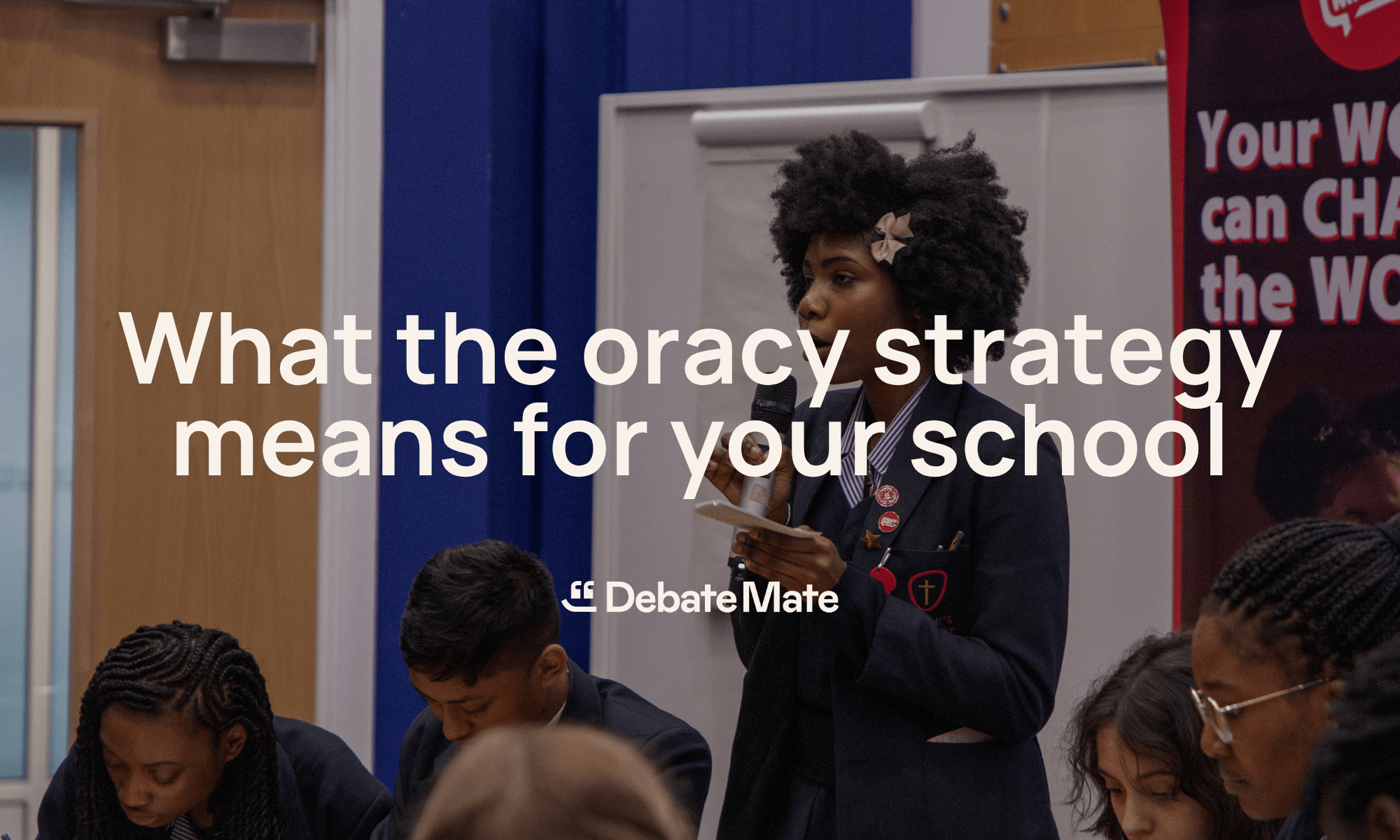
Oracy has featured on school leaders’ radar for years. But in 2025, the Department for Education published its National Oracy Strategy – the most significant government statement on spoken language in English education in a generation. For schools already investing in communication and debate, it was validation. For those who hadn’t yet prioritised it, it was a clear signal: the time to act is now.
So what does the strategy actually say? And more practically, what does it mean for your school?
What the Strategy Covers
The DfE strategy positions oracy not as enrichment, but as a core component of a quality education. It addresses three main areas.
Curriculum integration. The strategy calls for oracy to run throughout the curriculum — not confined to English lessons, but present across subjects. Science discussions, history debates, mathematical reasoning aloud. Speaking and listening must be explicitly planned for, not assumed to happen naturally.
Teacher development. The strategy acknowledges that most teachers received little or no training in oracy pedagogy. It sets out a CPD agenda that asks schools to develop their staff’s ability to teach spoken communication — not just assess it after the fact.
Assessment. This is where the debate runs hottest. The strategy stops short of mandating formal oracy assessment at GCSE level, but it signals a clear direction of travel. Schools that build strong oracy practice now are in a far stronger position when — not if — that changes.
Why This Matters Now, Not Later
The strategy doesn’t change what strong schools were already doing. Oracy-rich environments, debate clubs, structured talk time — none of these are new ideas. But the strategy does change the context in which school leaders decide where to invest. Oracy is no longer a programme that requires defending. It’s a national priority. And that shifts the budget conversation, the Ofsted readiness conversation, and the expectations parents bring to your school.
The Education Endowment Foundation’s Teaching and Learning Toolkit rates oral language interventions as delivering an average of five additional months of progress for disadvantaged pupils — one of the strongest returns in their entire dataset. For schools with Pupil Premium funding, that is a straightforward case to make.
Oral language interventions also produce gains in reading comprehension, vocabulary development, and academic confidence — benefits that ripple across the curriculum, not just into dedicated oracy sessions.
What the Strategy Means in Practice
The honest answer is that schools are at very different starting points. A blanket recommendation doesn’t serve any of them well. Here is a more useful way to think about it.
If you’re just starting out: Now is the right moment to begin. Even small, intentional steps – structured discussion tasks built into existing lessons, a debate club as after-school provision – count as a serious start. The priority is making oracy deliberate, not accidental.
If you already have strong oracy practice: Document it. The strategy gives you a framework to articulate what you’re already doing and why it matters. Use it to sharpen CPD plans, strengthen how you communicate oracy outcomes to parents, and position your provision confidently in Ofsted conversations.
If you’re somewhere in between: Prioritise teacher development first. The strongest oracy programmes are teacher-led – not dependent on external providers alone. CPD that builds staff confidence in oracy pedagogy pays dividends for years.
The Role of Debate
Debate is one of the most evidence-backed approaches to building oracy skills – not simply because it requires speaking, but because it demands the specific kind of structured, high-stakes spoken communication the DfE strategy prioritises: constructing an argument, responding to challenge, listening critically, and adapting a point for a live audience.
Debate also levels the playing field. Pupils who struggle to express themselves in writing often find their voice through structured spoken argument. That’s not a coincidence. It’s why debate has anchored disadvantage-reduction programmes in schools for decades.
At Debate Mate, we work with schools across the UK to deliver high-quality, debate-led oracy provision — through weekly after-school debate clubs, teacher training, and tailored school assemblies. Our programmes align directly with the competencies the DfE strategy prioritises, and we specialise in the schools where the impact matters most.
FAQs
The DfE National Oracy Strategy is the UK government’s framework for making spoken communication a formal priority in English schools. It covers how oracy is taught across the curriculum, professional development for teachers in oracy pedagogy, and the future direction for how spoken language may be assessed in schools.
The strategy sets a direction, not overnight mandates. It signals clearly that oracy will feature more prominently in inspection frameworks and, in time, assessment structures. Schools that act now build the culture and practice that makes future requirements straightforward to meet.
Debate develops the specific competencies the strategy prioritises: constructing arguments, listening critically, responding to challenge, and adapting a message for a live audience. It’s one of the most evidence-backed methods for building oracy skills – and it works particularly well for pupils who find traditional literacy-focused tasks harder.
Yes. The Education Endowment Foundation’s research shows oral language interventions deliver an average of five additional months of progress for disadvantaged pupils – one of the strongest returns in their Teaching and Learning Toolkit. This makes oracy provision, including debate programmes, straightforward to justify as Pupil Premium expenditure.
Oracy teaching happens across the curriculum: structured discussion tasks, planned talk time, vocabulary development. A debate club provides a focused weekly environment where pupils practise high-stakes spoken communication under real conditions. The two reinforce each other – curriculum oracy builds the habit, debate builds the skill.
