
Over 50% of private schools have debate clubs. Just 18% of state schools do. Here’s why that gap matters – and what Debate Mate is doing to close it.
The Problem with How We Think About Debate Clubs
What comes to mind when you hear the phrase ‘Debating clubs’? Maybe rooms reeking of pretentious energy, or conversations prioritising point-scoring or attempts to be the ‘smartest in the room ’. These assumptions don’t come from nowhere. Popular media often depicts fictional debaters as arrogant or socially awkward. Debating clubs are historically (and currently) much more prevalent in private schools, with research finding that over 50% of private schools have debate clubs compared to just 18% of state schools.
Debate Mate Is Leading The Change
But debating should not be stigmatised and, more importantly, it should not be exclusive – Debate Mate is a part of this change. They are a global educational charity and social business that runs debate programmes both during and after school hours in underfunded areas to facilitate social mobility. They teach the foundations of debating through interactive games to children aged 4-16 across the UK year-round, and in other countries each
summer.
What a Session Actually Looks Like
In practice, a lesson is never the same. It takes multiple weeks to look anything like a typical debating club. There are no podiums and no expectations that students arrive with debate knowledge. Sessions prioritise what works for the students. Structured enough to steadily teach the mechanics of a good argument, but loose enough to ensure a lighthearted atmosphere.
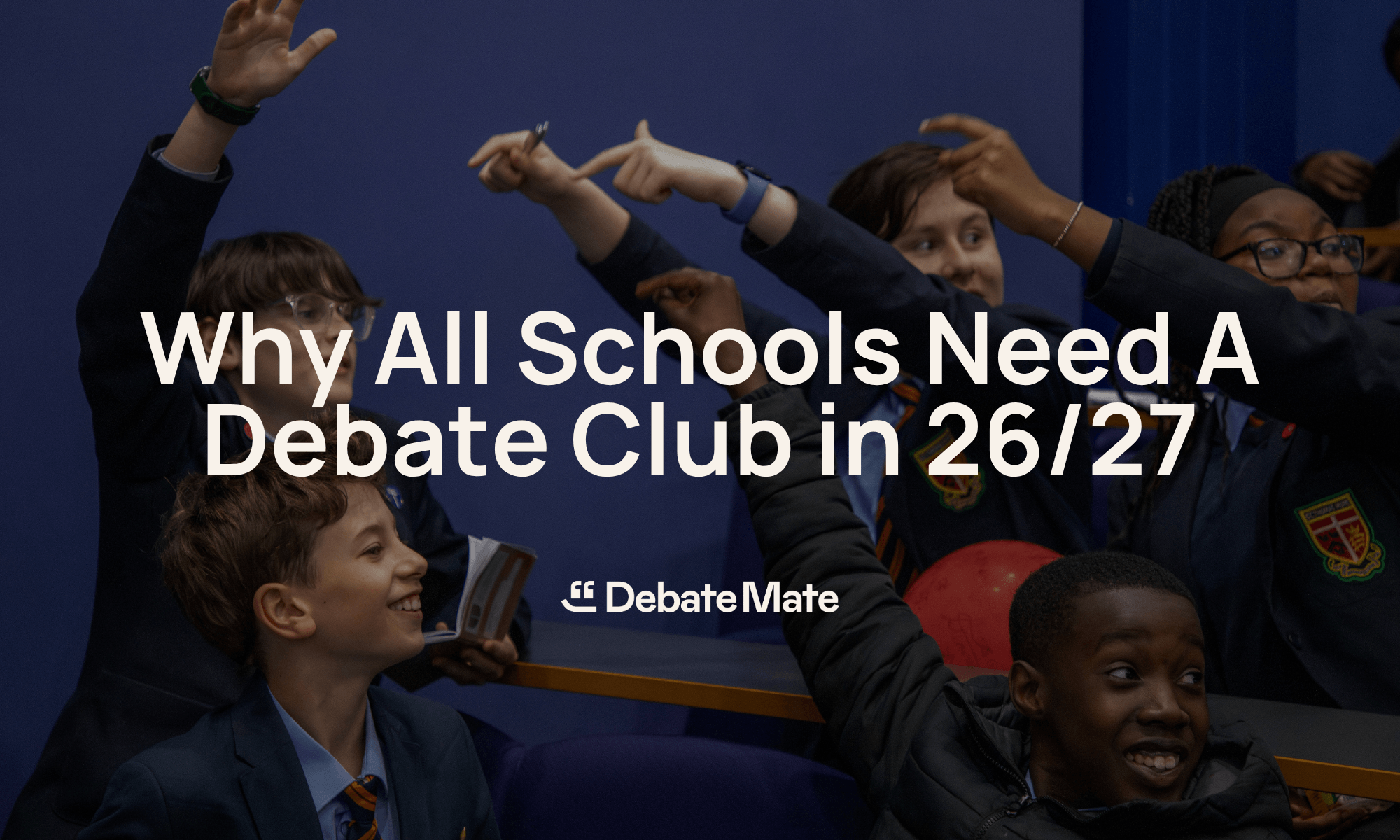
Progress is measured on an individual basis; for some it’s about mastering a skill they will certainly carry into their career, but it’s also about getting a student who hasn’t volunteered an opinion in months to finally put their hand up.
The Real Goal: Communication, Not Competition
Whilst the end goal is to get students in a position to partake in formal debating, the broader goal is much simpler: to improve communication and articulation skills in an effort to equip future generations with the confidence to explain why they believe something, why it matters and why they should be listened to.
Why This Matters More Than Ever
Once sidelined as ‘soft skills’, the importance of clear communication is growing in value in a society that is becoming increasingly reliant on tech and data. There are many things that AI can do (and does do), but human success is rooted in uniquely human attributes. Our ability to be excellent mediators, teachers, storytellers and leaders is the reason that the human race has come further than any other living thing.
So as we enter a new age of technology, we must not let the art of communication and critical thinking slip away. That starts with children, who have the most to lose. As adults, we have the responsibility to protect their voice before an entire generation grows up without ever having developed one.
The Habits We Are Quietly Losing
It is obvious to everyone that attention spans are shrinking; many of us struggle to read entire articles – with an option to Google a quick answer. People opt for a scroll to get their dopamine fix rather than a whole movie. Alongside this, the likelihood of an unplanned interaction with a stranger is becoming increasingly rare.
People rarely queue for banks when the answers can be promptly found on an app. More people order takeaways than try somewhere new. We stand at bus stops with headphones in to avoid interaction with people we don’t know.
These are small things individually – but together they are quietly eroding the very habits that make us good communicators.
Children Are Growing Up Without Building These Skills
And if adults are struggling, then as with most things, children are even more vulnerable. They are growing up with this as their norm. They are not losing a skill they once had, but many are never getting the chance to build it in the first place.
This is the gap that Debate Mate wants to help close. Getting into schools, specifically the ones without the resources to prioritise this, and giving students a space to practise skills that no algorithm can replace: talking to one another, disagreeing, listening and being heard.
If we do not equip young people with the tools and skills for the future, we cannot expect them to succeed in the workplace.
