
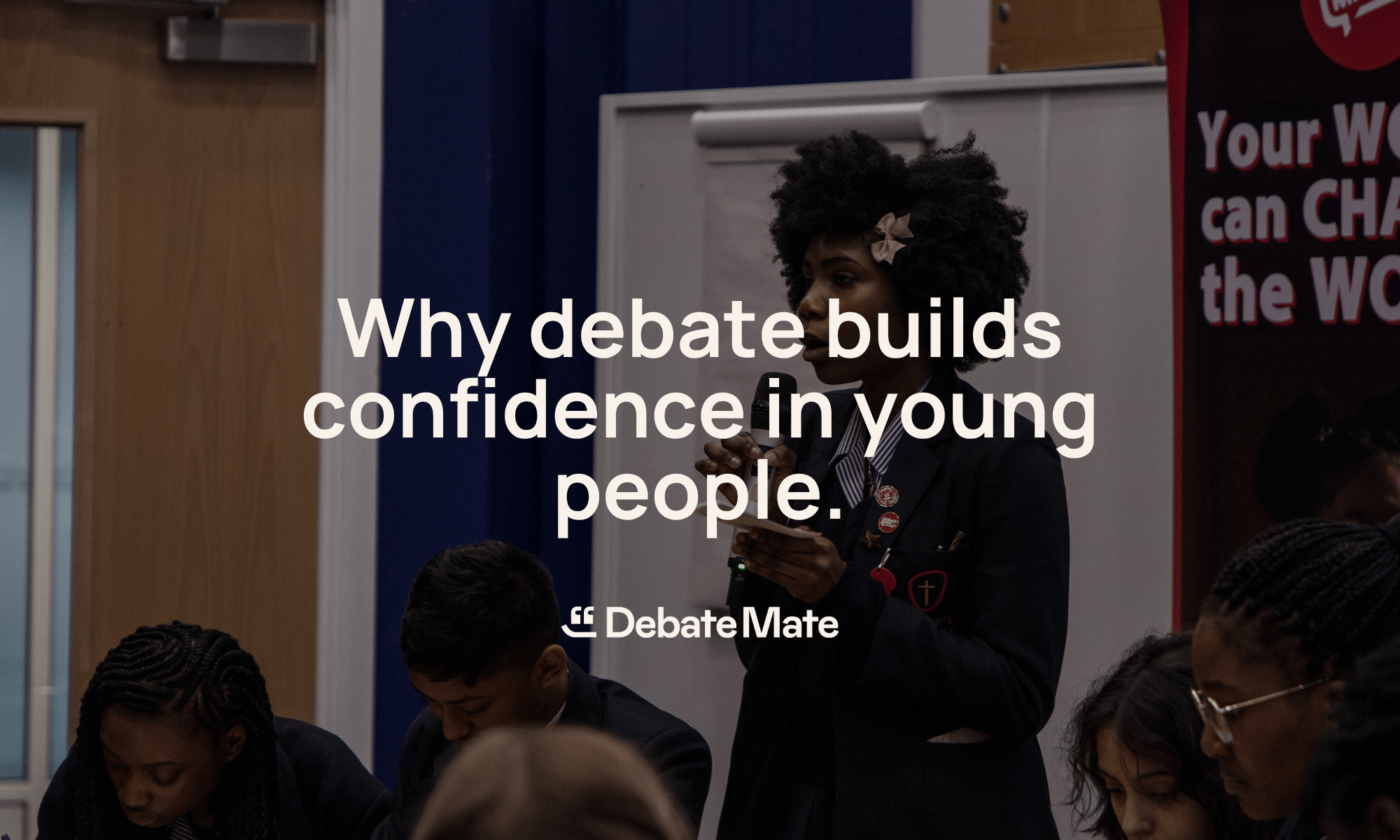
Schools lean heavily on one confidence-building tool: praise.
Tell a young person they did well, celebrate their contribution, and make sure no one feels bad for getting an answer wrong. A supportive environment matters. But praise alone does not build confidence.
It produces something that looks like it, until the moment it is tested.
Real confidence that holds up in a job interview, a presentation, or a room where someone disagrees comes from having been tested before and having survived it.
Debate is one of the most direct ways to create that experience.
What does debate actually demand of a young person?
When a student debates, they have to understand their argument well enough to explain it, anticipate what the other side will say, and hold their position when someone comes back at them. No script. No safety net. Just thinking on their feet in front of an audience.
The moment a young person holds a position, has it challenged, and finds the words to respond, they figure out that disagreement is survivable. That their thinking holds up. Speaking in a room where someone pushes back is uncomfortable but manageable.
You cannot get that from a worksheet; you have to actually do it.
The confidence gap schools often miss
Most schools invest heavily in subject knowledge and academic skills. The confidence to use those skills in a seminar, a job interview, or a difficult professional conversation is treated as something that either develops naturally or doesn’t – more personality than pedagogy.
Research on oracy development consistently shows that students who practice speaking and defending ideas improve, including those who would never describe themselves as confident speakers. The improvement is not limited to the naturally outgoing.
The gap between what students know and what they can communicate under pressure is often larger than schools realise. A student who writes an excellent essay can freeze in a seminar. A student who understands an argument in depth can lose it the moment someone pushes back. These are not intelligence gaps. They are practice gaps, and they can be closed.
Why debating is particularly effective
Other approaches, such as oracy, public speaking, drama, and presentations, all develop overlapping skills. Debate has a specific quality that sets it apart: it forces a student to respond to someone else’s thinking in real time, with no preparation for what they will specifically say.
That unpredictability is the thing. The student cannot rely on a rehearsed script. They have to listen, process, and respond on the spot. These conditions come closer than almost anything else to the high-stakes communication situations that will actually matter in their lives.
The young people who have done this regularly are more capable of listening while still thinking. More willing to engage with a view they disagree with, rather than stepping back from it or being rattled by it.
What this looks like in practice
At Debate Mate Schools, we work directly with students in schools, building these skills progressively. The work starts with structure and listening, and moves towards the kind of practice that puts students under genuine, well-supported pressure.
The change we see most often is not in the students who arrived already confident. It is in the ones who arrived quietly, who are uncertain whether they had anything worth saying, and left with a clear sense that their thinking could be heard, challenged, and valued.
A note for schools
If you are thinking about how to build communication confidence into your curriculum, from September 2026, the question is not whether debate can help. The question is whether you are creating conditions where students are genuinely challenged and genuinely supported at the same time – not just told that they are doing well.
That combination, challenge alongside support, is where the development happens.
